
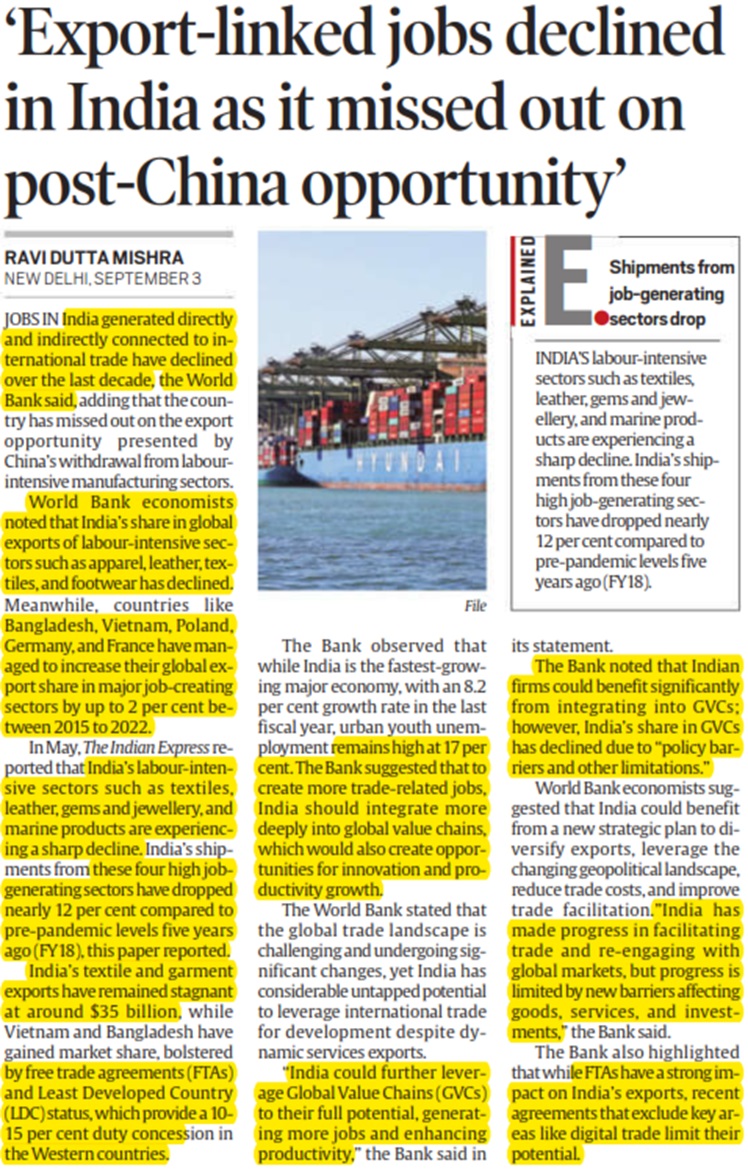
Export linked jobs declined in India as it missed out on post China opportunity
- India’s labour-intensive sectors such as textiles, leather, gems and jewellery, and marine products are experiencing a sharp decline.
Highlights:
- The World Bank has highlighted a concerning trend in India's international trade-related employment, which has seen a decline over the past decade.
- This downturn is linked to India's missed opportunities in the global export market, particularly in labor-intensive sectors such as textiles, apparel, leather, and footwear.
Declining Global Export Share in Labor-Intensive Sectors:
- India's share in global exports of labor-intensive sectors has been on a downward trajectory, contrasting with the growth seen in other countries. Between 2015 and 2022, nations like Bangladesh, Vietnam, Poland, Germany, and France have increased their share in these key job-creating sectors by up to 2%.
- This increase has been supported by factors such as free trade agreements (FTAs) and Least Developed Country (LDC) status, which provide significant duty concessions in Western markets.
- In contrast, India's exports in textiles and garments have stagnated at around $35 billion. Despite being the world's fastest-growing major economy with an 8.2% growth rate in the last fiscal year, India has not capitalized on the shift in global manufacturing, particularly as China withdraws from labor-intensive sectors.
Missed Export Opportunities and Stagnant Growth:
- India's failure to seize these opportunities has resulted in a decline in shipments from critical sectors such as textiles, leather, gems and jewelry, and marine products.
- As reported in May, these sectors have seen a nearly 12% drop in exports compared to pre-pandemic levels five years ago.
- This stagnation is particularly concerning given that these sectors are significant job generators. Urban youth unemployment in India remains high at 17%, underscoring the need for more trade-related jobs to absorb the growing workforce.
The Need for Deeper Integration into Global Value Chains:
- The World Bank emphasizes that India could create more jobs and spur productivity growth by integrating more deeply into global value chains (GVCs).
- However, India's share in GVCs has declined, hindered by policy barriers and other limitations. This decline is a missed opportunity for Indian firms, which could otherwise benefit significantly from such integration.
- The Bank suggests that a strategic plan is needed to diversify India's exports and better leverage the changing geopolitical landscape.
- Reducing trade costs, improving trade facilitation, and engaging more comprehensively with global markets are critical steps that could help India tap into its considerable untapped potential in international trade.
Limitations of Recent Free Trade Agreements:
- While FTAs have had a positive impact on India's exports, the World Bank notes that recent agreements have fallen short by excluding key areas like digital trade. This exclusion limits the potential benefits that could have been realized, particularly in an era where digital trade is increasingly central to global commerce.
Prelims Takeaways:
- FTA
- Global Value Chains (GVCs)