
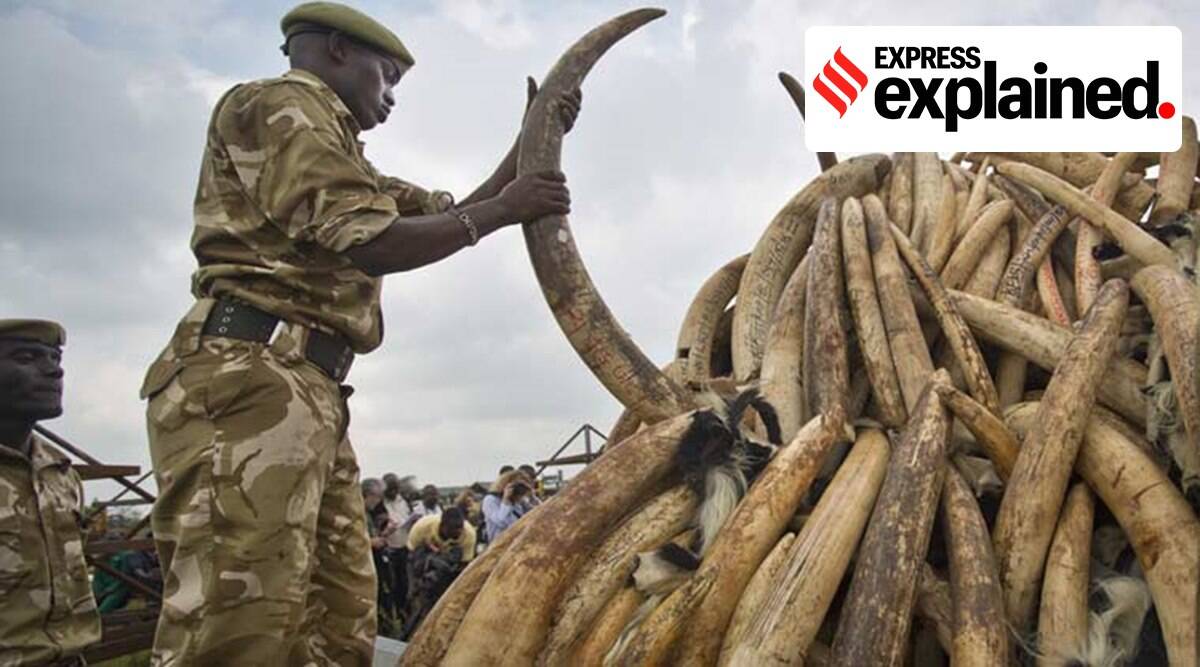
India's unusual abstention in CITES vote on reopening ivory trade
- Recently, India decided not to vote against a proposal to re-open the international trade in ivory at a conference of the CITES surprised many.
- A pioneer in banning even the domestic trade in ivory in 1986, India has always been at the forefront of global elephant conservation initiatives. CITES agreement
CITES agreement
- An international agreement between governments — 184 at present.
- Aim: to ensure that international trade in wild animals and plants does not threaten the survival of the species.
- Entered into force in 1975
- India became the 25th party — voluntarily agreed to be bound by Convention — in 1976.
- All import, export and re-export of species under it must be authorized through a permit system.
- Recently, India decided not to vote against a proposal to re-open the international trade in ivory at a conference of the CITES surprised many.
CITES Listing
- CITES Appendix I -
- Lists species threatened with extinction
- Import/ export permits for these are issued rarely
- Issued only if the purpose is not primarily commercial
- CITES Appendix II
- Includes species not necessarily threatened with extinction but in which trade must be strictly regulated.
Tussle over ivory
- International ivory trade was globally banned in 1989.
- All African elephant populations were put in CITES Appendix I.
- Populations of Namibia, Botswana, and Zimbabwe were transferred to Appendix II in 1997, and South Africa’s in 2000
- To allow 2 “one-off sales” in 1999 and 2008 of ivory from natural elephant deaths and seizures from poachers.
India and ivory trade
- 1975 - Endangered Asian elephant was included in CITES Appendix I.
- 1986 - India amended Wild Life (Protection) Act, 1972 to ban even domestic sales of ivory.
- 1991 - After the ivory trade was globally banned, India amended the law to ban the import of African ivory.
- 1981 - New Delhi hosted CoP3, India designed the iconic CITES logo in the form of an elephant.
- 1994 CoP9 - India opposed the down-listing of the elephant population of South Africa from Appendix I to II.
- 1997 CoP10: India opposed the proposal to down-list the southern African elephant populations.
- 2000 CoP11: India moved a proposal along with the host country to up-list all elephant populations in Appendix II to I.
- CoP17 and CoP18 - India voted against proposals to re-open trade in ivory from the southern African states.