
Institutional impetus to make India global millet hub
- Terming it as “shree anna”, the Union Budget accorded high priority to millets with Union Finance Minister announcing that institutional impetus will be given to make India a global hub for these nutritious grains.
- Indian Institute of Millet Research – Hyderabad, will be supported as Centre of Excellence for sharing best practices, research and technologies at the international level.
Millets
- About: A collective term referring to a number of small-seeded annual grasses cultivated as grain crops, primarily on marginal lands in dry areas in temperate, subtropical and tropical regions.
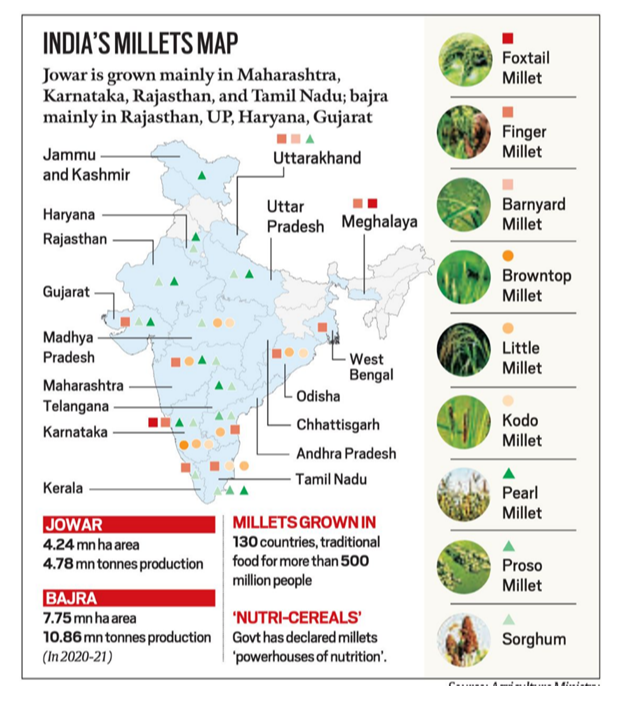
- Common millets in India: Ragi (Finger millet), Jowar (Sorghum), Sama (Little millet), Bajra (Pearl millet), and Variga (Proso millet).
- Grown in about 131 countries: It is the traditional food for around 60 crore people in Asia & Africa.
- Global Distribution: India, Nigeria and China account for more than 55% of the global production
- Largest producers: India, Nigeria and China account for more than 55% of the global production.
Benefits of Millets:
- Nutritional Security: cheap and more nutritious. For E.g. Ragi has the highest calcium content and high iron content and can fight the high prevalence of anaemia.
- Climate Resilient: they are known as hardy and drought-resistant crops. They require much less water than rice and wheat and are mainly grown in rainfed areas.
- Economic Security: low investment for inputs
- Fights Health Issues: Millets are gluten-free and have a low glycemic index (glucose level) and therefore can help in tackling lifestyle problems and health challenges such as obesity and diabetes.
- Have anti- aging and antioxidant properties
Prelims Takeaway
- Millet production in India