
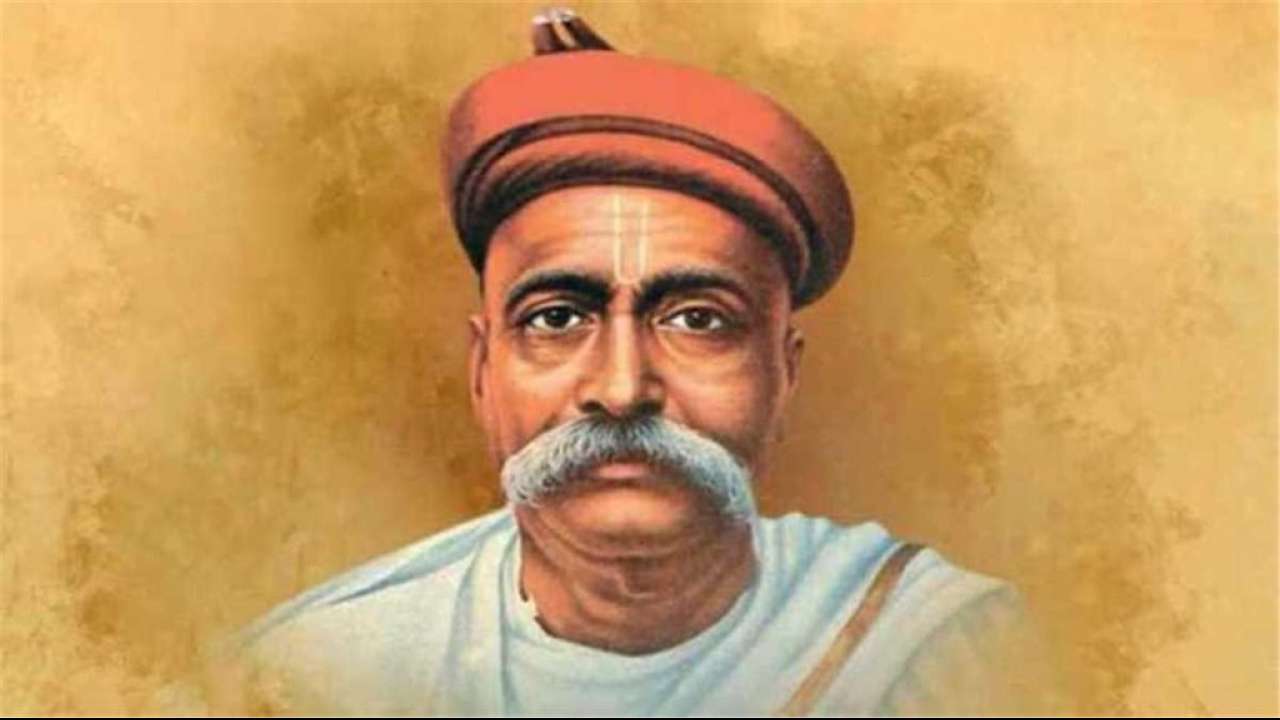
Lokmanya Tilak
- Birth Anniversary of Lokmanya Bal Gangadhar Tilak was observed on July 23.
- Tilak, was born in 1856 in Ratnagiri, Maharashtra, and was a fervent supporter of Swarajya throughout the liberation fight.
- He was a freedom warrior, social thinker, philosopher, and educator who was instrumental in India’s Independence effort.
Brief Biography
- He earned a Bachelor of Arts degree in Mathematics with honours from Deccan College in Pune in 1877.
- In 1879, Tilak graduated from Government Law College with an LL. B and established the Deccan Education Society in 1884 to impart nationalist principles to young people.
- Though, he was among India's first generation of youths to receive a modern, college education, Tilak strongly criticised the educational system followed by the British in India.
- He protested against the unequal treatment of the Indian students compared to their British peers and its total disregard for India’s cultural heritage.
- He started the Deccan Educational Society with college batchmates, Vishnu Shastry Chiplunkar and Gopal Ganesh Agarkar for the purpose of inspiring nationalist education among Indian students.
- Tilak also founded two newspapers ‘Kesari’ in Marathi and ‘Mahratta’ in English.
- Tilak joined the Indian National Congress in 1890.
- He soon started vocalizing his strong opposition to the moderate views of the party on self-rule and discarded simple constitutional agitation as futile.
- This subsequently made him stand against the prominent Congress leader, Gopal Krishna Gokhale. He wanted an armed revolt to broom-away the British.
- Due to this fundamental difference in outlook, Tilak and his supporters came to be known as the extremist wing of Indian National Congress Party.
- Tilak’s endeavours were supported by fellow nationalists Bipin Chandra Pal of Bengal and Lala Lajpat Rai of Punjab. The trio came to be popularly referred to as the Lal-Bal-Pal.
Imprisonment and Death
- During 1896, an epidemic of bubonic plague broke out in Pune and the adjacent regions and the British employed extremely rigorous measures to contain it.
- Under directives from Commissioner W. C. Rand, the police and the army invaded private residences, violated personal sanctity of individuals, burned personal possessions and prevented individuals to move in and out of the city.
- Tilak protested against the oppressive nature of the British efforts and wrote provocative articles on it in his newspapers.
- His article inspired the Chapekar brothers and they carried out assassination of Commissioner Rand and Lt. Ayerst on June 22, 1897.
- As a result of this, Tilak was imprisoned for 18 months on Sedition charges for inciting murder.
- During 1908-1914, Bal Gangadhar Tilak spent had to undergo six years of rigorous imprisonment in Mandalay Jail, Burma.
- He openly supported the revolutionaries Khudiram Bose and Prafulla Chaki’s efforts to assassinate Chief Presidency Magistrate Douglas Kingsford in 1908.
- Tilak returned to India in 1915 when the political situation was fast changing under the shadow of the World War I.
- There was unprecedented celebration after Tilak was released.
- Deciding to re-unite with his fellow nationalists, Tilak founded the All India Home Rule League in 1916 with Joseph Baptista, Annie Besant and Muhammad Ali Jinnah.
- He rejoined the Indian National Congress but could not bring about reconciliation between the two opposite-minded factions.
- Tilak suffered from diabetes and had become very weak by this time. In mid-July 1920, his condition worsened and on August 1, he passed away.
Social Reforms:
- Tilak was a great reformer and throughout his life he advocated the cause of women education and women empowerment.
- Tilak educated all of his daughters and did not marry them till they were over 16.
- Tilak proposed Grand celebrations on ‘Ganesh Chaturthi’ and ‘Shivaji Jayanti'. He envisioned these celebrations inciting a sense of unity and inspiring nationalist sentiment among Indians. It is a sheer tragedy that for his allegiance towards extremism, Tilak and his contribution were not given the recognition, he actually deserved.