
Over 64,000 people in India die of snakebites each year : Study
- A study recently estimated that a vast majority of snakebite deaths globally — up to 64,100 of the 78,600 deaths — occur in India.
- Also suggests that the global target of halving the number of deaths and injuries from snakebite by 2030 is unlikely to be met.
About the study
- Used data from verbal autopsy and vital statistics (civil registration) to estimate snakebite deaths from the Global Burden of Disease 2019 study.
- Before the study, India was considered responsible for up to half of the global deaths due to snakebite.
- Current study shows snakebite deaths in India are much higher at almost 80% of the global deaths.
Statistics in India
- UP has the highest number of deaths (16,100), followed by MP (up to 5,790 deaths), and Rajasthan (up to 5,230 deaths).
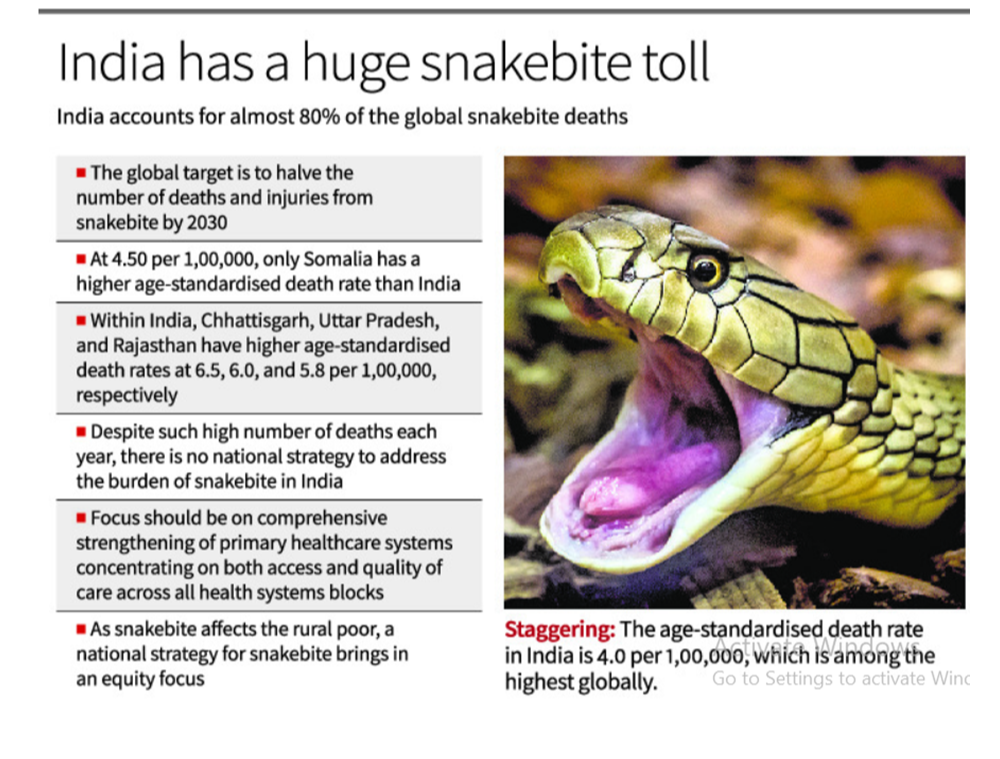
- Age-standardised death rate in India
- 4.0 per 1,00,000
- Among the highest globally
- Many times over than the global figure of 0.8 deaths per 1,00,000.
- Only Somalia has a higher age-standardised death rate than India at 4.5 per 1,00,000.
- Chhattisgarh, Uttar Pradesh, and Rajasthan have even higher age-standardised death rates (6.5, 6.0, and 5.8 respectively).
Issues in India and steps to be taken
- No national strategy to address the burden of snakebite in India.
- Preventing snakebite needs more than simple awareness programmes.
- Because snakebite is due to snake-human-environment conflict tied to many socio-cultural-religious aspects.
- Understanding the conflict and code signing community-based programmes for prevention of snakebites which are tested through community randomised cluster trials are required.
- To bring down deaths, strengthening of primary healthcare in India is also required.
Focus on healthcare
- No sole focus on snake antivenom availability.
- Need for comprehensive strengthening of primary healthcare systems focusing on both access and quality of care
- Improving primary health care is important because it is an acute medical emergency.
- The global target to halve snakebite deaths by 2030, cannot be attained without action in India.
- Global health funders and philanthropists should invest for research and programmes on snakebite in India.
Conclusion
- Because snakebite affects the rural poor, a national strategy for snakebite brings in an equity focus which will bring cross benefits for other neglected tropical diseases, which happen in the same communities.