
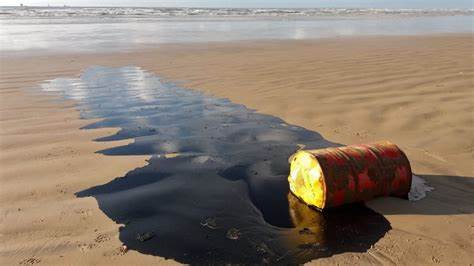
Pollution Control Board issues notice to MRPL on oil leak
- Recently Karnataka State Pollution Control Board issued a show-cause notice to Mangalore Refinery and Petrochemicals Ltd. (MRPL) asking it to submit an action taken report immediately on removal of oil spills in the marshy land.
Oil Spills:
- Oil spills are leakages or spillage of petroleum and its byproducts into the environment particularly onto the surface of huge water bodies such as oceans, lakes, and rivers.
- It is principally applied to describe the spillage of oil in marine systems. However, oil spills may occur on land too.
Oil Environmental Impact on Habitat , Air and Wildlife:
- Habitat destruction is all too obvious with an oil spill.
- The most visible would be seen onshore, but beneath the water, there is a very delicate balance in the reefs and shallow-water habitats.
- Plankton, producers at the bottom of the food chain, are often killed by oil spills as a result of changes to the water and lack of sunlight beneath the oil slick.
- This effect moves right on up the food chain.
- Of particular concern are the very delicate sea animals, such as clams and mussels that feed on plankton.
- Direct contact with oil harms any organism that comes in contact with the oil.
- For example, when oil cakes the feathers of a bird, it keeps their feather from repelling water. Oil also weighs down the bird, keeping it from flying.
- If a bird isn't cleaned off the oil, it's a sure license to death.
- Many birds also ingest deadly amounts of oil trying to clean their feathers.
- The same holds true for marine mammals. Marine mammal fur acts as an insulator to keep the animal warm in the coldest waters.
- When oil saturates the fur, it ruins the ability of the fur to retain heat. Again, marine mammals can ingest the oil when trying to clean their fur.
- There are three kinds of oil-consuming bacteria. Sulfate-reducing bacteria (SRB) and acid-producing bacteria are anaerobic, while general aerobic bacteria (GAB) are aerobic.
- These bacteria occur naturally and will act to remove oil from an ecosystem, and their biomass will tend to replace other populations in the food chain.
- During the cleanup and recovery process, it will also generate air pollutants such as nitric oxides and ozone from ships. Lastly, bubble bursting can also be a generation pathway for particulate matter during an oil spill.
- During the Deepwater Horizon oil spill, significant air quality issues were found on the Gulf Coast, which is the downwind of the DWH oil spill.
- Air quality monitoring data showed that criteria pollutants had exceeded the health-based standard in the coastal regions.
Methods for cleaning up include:
- Bioremediation: use of microorganisms or biological agents to break down or remove oil.
- Bioremediation Accelerator: a binder molecule that moves hydrocarbons out of the water and into gels, when combined with nutrients, encourages natural bioremediation.
- Controlled burning can effectively reduce the amount of oil in water if done properly. But it can only be done in low wind and can cause air pollution.
- Dispersants can be used to dissipate oil slicks.
- A dispersant is either a non-surface active polymer or a surface-active substance added to a suspension, usually a colloid, to improve the separation of particles and to prevent settling or clumping.
- Watch and wait: in some cases, natural attenuation of oil may be most appropriate, due to the invasive nature of facilitated methods of remediation, particularly in ecologically sensitive areas such as wetlands.
- Dredging: for oils dispersed with detergents and other oils denser than water.
- Skimming: Requires calm waters at all times during the process.
- Solidifying: Solidifiers are composed of tiny, floating, dry ice pellets, and hydrophobic polymers that both adsorb and absorb.
- They clean up oil spills by changing the physical state of spilled oil from liquid to a solid, semi-solid or a rubber-like material that floats on water.
- Vacuum and centrifuge: Oil can be sucked up along with the water, and then a centrifuge can be used to separate the oil from the water – allowing a tanker to be filled with near pure oil.
- Beach Raking: coagulated oil that is left on the beach can be picked up by machinery.