
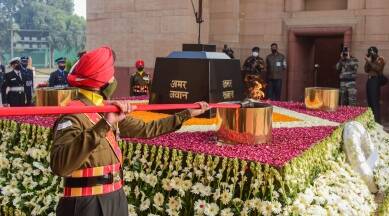
Relocating the Amar Jawan Jyoti to National War Memorial is logical, and beyond reproach
- The government has put out the eternal flame of the Amar Jawan Jyoti underneath India Gate and merged it with the one instituted at the National War Memorial in 2019 a few hundred meters away.
- The decision kicked off a political row, with Opposition leaders claiming that it was a disrespect to the soldiers who have laid down their lives fighting for the country.
What was the Amar Jawan Jyoti and why was it constructed?
- The eternal flame at the Amar Jawan Jyoti underneath India Gate in central Delhi was an iconic symbol of the nation’s tributes to the soldiers who have died for the country in various wars and conflicts since Independence.
- Established in 1972, it was to mark India’s victory over Pakistan in the 1971 War, which resulted in the creation of Bangladesh.
- The then Prime Minister Indira Gandhi had inaugurated it on Republic Day 1972, after India defeated Pakistan in December 1971.
- The key elements of the Amar Jawan Jyoti included a black marble plinth, a cenotaph, which acted as a tomb of the unknown soldier.
- The plinth had an inverted L1A1 self-loading rifle with a bayonet, on top of which was a soldier’s war helmet.
- The installation had four urns on it, with four burners.
- On normal days one of the four burners were kept alive, but on important days like the Republic Day, all four burners were lit.
- These burners were what is called the eternal flame, and it was never allowed to be extinguished.
Why was it placed at India Gate?
- The India Gate, All India War Memorial, as it was known earlier, was built by the British in 1931.
- It was erected as a memorial to around 90,000 Indian soldiers of the British Indian Army, who had died in several wars and campaigns till then.
- Names of more than 13,000 dead soldiers are mentioned on the memorial commemorating them.
- As it was a memorial for the Indian soldiers killed in wars, the Amar Jawan Jyoti was established underneath it by the government in 1972.
Why was the eternal flame extinguished from there?
- Defence establishment officials said that once the National War Memorial came up in 2019, Indian political and military leaders and foreign dignitaries pay their tributes to the fallen soldiers at the National War Memorial, which used to happen at the Amar Jawan Jyoti earlier.
- With this change it was felt that two flames were not needed, even though when the National War Memorial was built officials had categorically stated that both the flames will be kept alive.
- But another reason is that the Amar Jawan Jyoti was etched so strongly in the emotional psyche of the country that the new war memorial did not get the attention as the government had expected, and the government wants to promote the new memorial it built in 2019.
- Further, it can also be seen as part of the government’s redevelopment of the entire Central Vista, of which India Gate, the Amar Jawan Jyoti and the National War Memorial are parts of.