
Researchers find anti-cancer activity in marine seagrass
- Researchers have found scientific evidence of a strong anti-cancer activity in the ethyl acetate fraction of Halodule uninervis, a species of seagrass found in the coastal region of Mandapam close to Rameswaram in southern Tamil Nadu.
- The study, claimed to be the first of its kind, was aimed at evaluating the in-vitro anti-cancer activity of ethyl acetate fraction of this seagrass species against various human cancer cell lines, including malignant melanoma, lung, cervix, carcinoma and colorectal cancers.
Seagrass
- Underwater plants - evolved from land plants.
- Terrestrial plants - leaves, flowers, seeds, roots & connective tissues.
- Food - from photosynthesis.
- Submarine pollination : water carried pollen fertilize female flowers or send out rhizome roots to sprout new growth.
Difference - seagrasses & terrestrial plants
- Seagrasses no strong stems : supported by the water buoyancy.
- Seagrass ecosystem : widespread compared to coral & mangrove ecosystems.
- All coastal areas of the world except the polar regions.
Indian seagrass habitats
- Mainly limited to mud flats and sandy regions.
- Extends from the lower inter-tidal zone to depths of 10-15m.
- Open shores and in the lagoons around the islands.
- Gulf of Mannar and Palk Bay harbour the maximum number of species followed by Andaman and Nicobar and Lakshadweep islands.
Importance
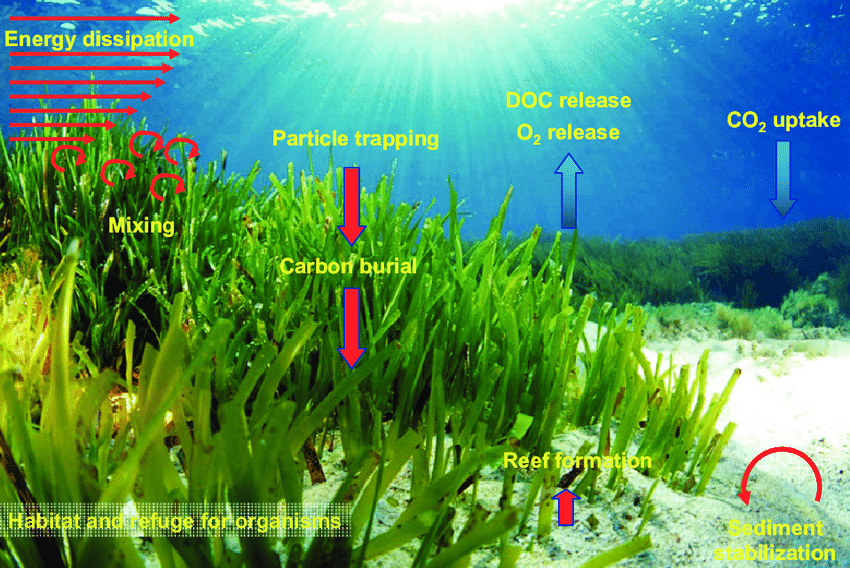
- Help lessen the effects of strong ocean currents.
- Provide a place for eggs and larvae to attach : good nursery area for many fish and invertebrates.
- Produce energy through photosynthesis : very sensitive to water quality.
- An indicator of the overall health of the coastal ecosystems.
- Provide food for herbivores : sea turtles, dugongs and manatees.
- Dead seagrasses provide food for decomposers : worms,sea cucumbers ,crabs & filter feeders.
- Oraganisms : plankton, algae, and bacteria grow on the stems of these seagrasses. * Improve water quality : trapping sediments, absorbing nutrients & stabilizing sediment with their roots : ecosystem engineers.
- Carbon sink : apacity to sequester carbon dioxide from the atmosphere.
- Warriors of ocean acidification : always cause an increase in pH. Withdrawal of CO2 : photosynthesis. Protons of carbonic acid : removed. Presence reduces ocean's acidic nature.
- Preparation of medicines and chemicals.
Major threats
- Sea-level rise : coastline modification.
- Global changes : atmospheric CO2 & water temperature.
- Erosion, siltation & hydrologic modification destruction of sand dunes & coastal zones.
- Eutrophication : excess nutrients or sewage discharge into coastal waters.
- Destructive fishing, coastal development : ports, navigation channels, ship building yards, anchoring of boats,etc.
- Increased growth of invasive species : seaweeds.
India's initiatives
- Project : Community-supported management and conservation strategies for seagrass beds in Palk Bay.
- Main objective : To economically evaluate seagrass, To develop community-based management & conservation strategies,To optimise wise-use of seagrass beds.
- Conference on segrass conservation MoEFCC."