
Words from Bandung to relive in Bali and Delhi
- Three summits i.e BRICS, G-7 summit and NATO Summit have cleared stands on Ukraine crisis.
Recent happenings
- The Indian PM attended the BRICS summit and G-7 outreach between seven members and special invitees - Argentina, Indonesia, India, Senegal and South Africa.
- Some of the impact will be clearer at the G-20 meet in Indonesia where India takes over the G-20 presidency in December.
BRICS summit
- Host: Chinese President.
- Significance: First multilateral grouping Russian President attended since Ukraine was invaded.
- India at BRICS:
- Commitment to an alternate grouping of economies
- Refusal to shun Russia
- Set aside a two-year stand-off with China’s PLA at LAC in favour of multilateral meetings such as BRICS and Shanghai Cooperation Organization (SCO).
- BRICS Beijing Declaration: Consensus document
- Each member cited differing “National Positions” on the Ukraine issue.
- BRICS Economic initiatives: To Contain challenges to western-led sanctions regime against Russia.
- New Development Bank (NDB) approved about 17 loans for Russian energy and infrastructure projects.
- Contingent Reserve Arrangement (CRA), and BRICS Payments Task Force (BPTF) for coordination b/w their central banks for an alternative to SWIFT payments system.
- Building global reserve currency based on a “basket of currencies” and trading in local currencies.
- Russia committed to providing more oil and coal supplies to BRICS countries.
G-7 outreach
- Targeted Russia’s war in Ukraine and China’s economic aggression.
- Its outreach documents on “Resilient Democracies” and “Clean and Just Transitions towards Climate Neutrality” were devoid of any mentions of either.
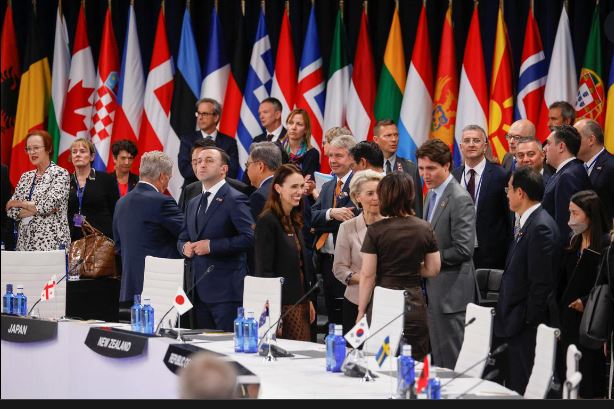
NATO Meeting
- Group comprising U.S., Canada and European countries committed to more NATO actions against “Russian aggression”.
- Reference to “systemic competition” from China as a challenge to NATO “interests, security and values”.
- Five countries applied to join NATO - Finland, Georgia, Sweden, Ukraine and Bosnia Herzegovina.
- Message: NATO would no longer consider Russian sensitivities for NATO expansion
Launch of another Indo-Pacific coalition
- “Partners in the Blue Pacific” (PBP) comprising the U.S., the U.K., Australia, New Zealand and Japan.
- Addition to Australia-U.K.-U.S. (AUKUS).
- Significance: U.S.’s growing focus on countries that have military alliances with, against its adversaries.
India must lead
- India’s Commitment to a singular strategy that does not condone Russia for its attacks on Ukraine, but one that does not criticize it either.
- India is working to diversify its defence purchases from Russia, hostilities with China are high, and a strategic tilt towards the U.S. and Quad partners in the Indo-Pacific is growing.
- India as a balancing voice: with Brazil and South Africa, ensuring that BRICS Beijing declaration did not carry the Russian position on the Ukraine war or any criticism of the West.
- This tightrope walk is unlikely to suffice as a long-term strategy.
- Time for India to seize the moment for leadership in a world that is becoming increasingly uncomfortable with the growing polarization and the disruption due to the Ukraine war.
- As the next President of the G-20, India must ensure that the G-20 stays together, and reassure those worried by the brinkmanship of the West on one side and Russia and China on the other.
Words that matter
- 1955: India took leadership of at Bandung conference that led to Non-Aligned Movement (NAM).
- While the present government has shown little interest in NAM or even in Nehruvian thought, it may be necessary to reconsider Nehru’s words in a world fraught with danger nearly 70 years later.