
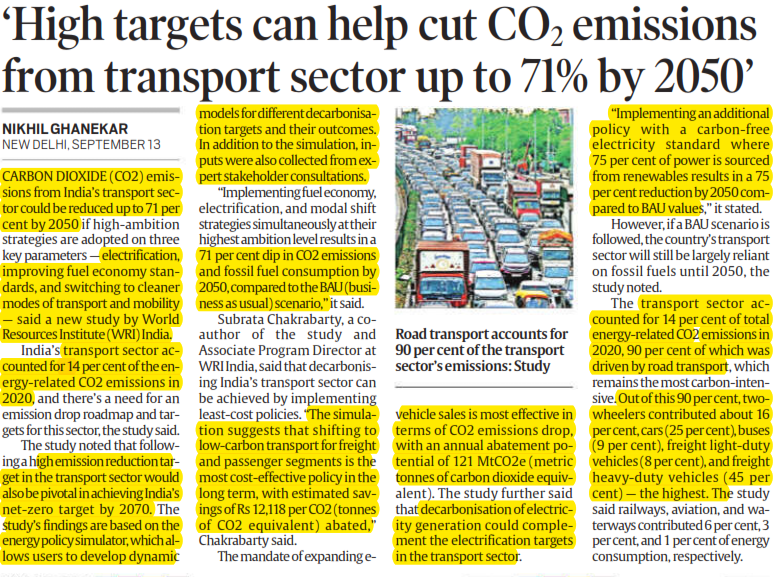
High targets can help cut Co2 emission from transport sector upto 71% by 2050
- Carbon dioxide emissions from India’s transport sector could be reduced up to 71 per cent by 2050 if high-ambition strategies are adopted on three key parameters – electrification, improving fuel economy standards.
Highlights:
- A new study by the World Resources Institute (WRI) India suggests that carbon dioxide (CO2) emissions from India’s transport sector could be reduced by up to 71% by 2050 through the adoption of high-ambition strategies. These strategies focus on three key areas:
- Electrification
- Improving fuel economy standards
- Switching to cleaner modes of transport and mobility
Current Scenario and the Need for Change:
- In 2020, India’s transport sector was responsible for 14% of the total energy-related CO2 emissions, with 90% of these emissions coming from road transport.
- Without intervention, the country’s transport sector is expected to remain fossil fuel-dependent until 2050. Fossil fuel consumption is predicted to quadruple, driven by the growth in passenger and freight travel demand.
Decarbonisation Strategies and Potential Impact:
- The study, which used the energy policy simulator and inputs from stakeholder consultations, emphasizes the need for:
- Simultaneous Implementation of Ambitious Strategies: Achieving a 71% reduction in CO2 emissions and fossil fuel consumption by 2050 requires the implementation of the highest ambition levels in electrification, fuel economy, and modal shifts.
- Electrification: Expanding electric vehicle (EV) sales is critical, with an annual abatement potential of 121 MtCO2e (metric tonnes of CO2 equivalent). This transition can be further supported by decarbonising electricity generation, aiming for 75% renewable energy sources by 2050, leading to an additional 75% reduction in emissions.
Economic Benefits:
- Cost-Effective Policy: According to Subrata Chakrabarty, co-author of the study, low-carbon transport is the most cost-effective approach. The estimated savings from these policies are Rs. 12,118 per tonne of CO2 abated.
Sectoral Contributions and Future Projections:
- Passenger and Freight Demand: By 2050, passenger travel demand is expected to triple, and freight demand could increase sevenfold.
- Emissions Breakdown: Two-wheelers, cars, buses, and freight vehicles account for significant portions of road transport emissions. The heaviest polluters are heavy-duty vehicles (HDVs), contributing 45% of road transport emissions.
Prelims Takeaways:
- World Resources Institute (WRI)