
Indian elephants lost genetic vigour as they moved north to south, 5 distinct populations exist: Study
- Bengaluru-based National Centre for Biological Sciences (NCBS) and the Indian Institute of Science (IISc) has found that the Indian elephant migrated from the north to the south over many millennia
Highlights:
- A team of researchers from the National Centre for Biological Sciences (NCBS) and the Indian Institute of Science (IISc) has uncovered new insights into the migration and genetic evolution of Indian elephants.
- The study, published in Current Biology, traces the north-to-south migration of elephants across India, revealing a progressive loss of genetic diversity as they moved southward over millennia.
Key Findings: Five Genetically Distinct Elephant Populations:
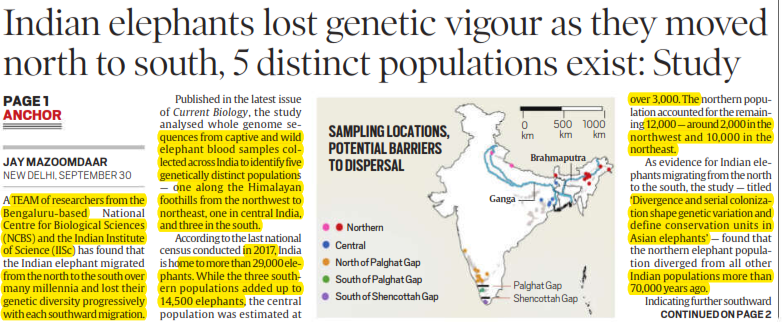
- By analyzing whole genome sequences from wild and captive elephant blood samples across India, the study identified five genetically distinct elephant populations:
- Himalayan Foothills Population: Extending from northwest to northeast India.
- Central Indian Population: Located between south-western West Bengal and eastern Maharashtra.
- Three Southern Populations:
- One north of the Palghat Gap.
- A second between the Palghat and Shencottah Gaps.
- The third, south of the Shencottah Gap, includes a vulnerable group of less than 150 elephants.
- According to the 2017 national census, India has over 29,000 elephants, with the southern populations accounting for 14,500, the central population around 3,000, and the northern population estimated at 12,000.
Migration Patterns and Loss of Genetic Diversity:
- The study demonstrates that Indian elephants migrated from the north to the south over tens of thousands of years:
- The northern population diverged from other populations around 70,000 years ago.
- The central Indian population diverged about 50,000 years ago.
- The three southern populations split approximately 20,000 years ago.
- The research highlights a phenomenon called the serial founder effect, where smaller groups of elephants migrated southward, leading to reduced genetic diversity with each new population.
- The elephants in the southernmost population, located south of the Shencottah Gap, now exhibit the lowest genetic diversity. This population of fewer than 150 elephants is considered the most vulnerable to extinction.
Conservation Implications:
- The study emphasizes the urgency of habitat connectivity to preserve genetic diversity among elephant populations. Recent infrastructure development has further fragmented elephant habitats, particularly in the Western Ghats, disrupting gene flow between the three southern populations.
- Researchers also shed light on a new geographic barrier to elephant movement, the Shencottah Gap, which divides elephant populations further than previously believed. Until now, the Palghat Gap was thought to be the main impediment to elephant movement along the Western Ghats.
Future Conservation Strategies:
- The findings underscore the need for region-specific conservation efforts to protect each genetically distinct population.
- Lead researcher Professor Uma Ramakrishnan emphasized the importance of developing a genetic toolkit using DNA extracted from elephant faeces to help accurately monitor these populations and track individual elephants in the wild.
Prelims Takeaways:
- National Centre for Biological Sciences (NCBS)