
NREGA: low funds, caste-based payment delays, and implications for the economy
- Last week, two organisations that track the implementation of the Mahatma Gandhi National Rural Employment Guarantee Act (MGNREGA) brought out a report — called MGNREGA Tracker — by using the government’s Management Information System (MIS) data.
- These two organisations are the People’s Action for Employment Guarantee (or PAEG, which is an umbrella organisation for several activists and academics who initially lobbied for the rural employment guarantee scheme and now track its implementation) and LibTech India (which brings together engineers, social workers and social scientists interested in improving public service delivery).
About MGNREGA:
- The scheme was introduced as a social measure that guarantees “the right to work”.
- The key tenet of this social measure and labour law is that the local government will have to legally provide at least 100 days of wage employment in rural India to enhance their quality of life.
Key objectives:
- Generation of paid rural employment of not less than 100 days for each worker who volunteers for unskilled labour.
- Proactively ensuring social inclusion by strengthening livelihood base of rural poor.
- Creation of durable assets in rural areas such as wells, ponds, roads and canals.
- Reduce urban migration from rural areas.
- Create rural infrastructure by using untapped rural labour.
The following are the eligibility criteria for receiving the benefits under MGNREGA scheme:
- Must be Citizen of India to seek NREGA benefits.
- Job seeker has completed 18 years of age at the time of application.
- The applicant must be part of a local household (i.e. application must be made with local Gram Panchayat).
- Applicant must volunteer for unskilled labour.
Key facts related to the scheme:
- The Ministry of Rural Development (MRD), Govt of India is monitoring the entire implementation of this scheme in association with state governments.
- Individual beneficiary oriented works can be taken up on the cards of Scheduled Castes and Scheduled Tribes, small or marginal farmers or beneficiaries of land reforms or beneficiaries under the Indira Awaas Yojana of the Government of India.
- Within 15 days of submitting the application or from the day work is demanded, wage employment will be provided to the applicant.
- Right to get unemployment allowance in case employment is not provided within fifteen days of submitting the application or from the date when work is sought.
- Social Audit of MGNREGA works is mandatory, which lends to accountability and transparency.
- The Gram Sabha is the principal forum for wage seekers to raise their voices and make demands.
- It is the Gram Sabha and the Gram Panchayat which approves the shelf of works under MGNREGA and fix their priority.
Role of Gram Sabha:
- It determines the order of priority of works in the meetings of the Gram Sabha keeping in view potential of the local area, its needs, local resources.
- Monitor the execution of works within the GP.
Roles of Gram Panchayat:
- Receiving applications for registration
- Verifying registration applications
- Registering households
- Issuing Job Cards (JCs)
- Receiving applications for work
- Issuing dated receipts for these applications for work
- Allotting work within fifteen days of submitting the application or from the date when work is sought in the case of an advance application.
- Identification and planning of works, developing shelf of projects including determination of the order of their priority.
Responsibilities of State Government in MGNREGA:
- Frame Rules on matters pertaining to State responsibilities under Section 32 of the Act ii) Develop and notify the Rural Employment Guarantee Scheme for the State.
- Set up the State Employment Guarantee Council (SEGC).
- Set up a State level MGNREGA implementation agency/ mission with adequate number of high calibre professionals.
- Set up a State level MGNREGA social audit agency/directorate with adequate number of people with knowledge on MGNREGA processes and demonstrated commitment to social audit.
- Establish and operate a State Employment Guarantee Fund (SEGF).
Underlying Challenges
- Inadequate Allocation and repeated payment delays
- The first finding has to do with the Government of India not allocating adequate funds for MGNREGA in the Budget for the current financial year.
- According to the PAEG, the total budget allocation for MGNREGA this year was 34% less than the revised budget of the last financial year (2020-21).
- Demand suppression
-
Another key takeaway is that inadequate allocation has a detrimental impact on people asking for a job. That’s because — argue the researchers to study the MGNREGA work sites — people seeking MGNREGA work cannot afford to not be paid for so long.
-
There are two important legislative provisions of MGNREGA. One, work should be provided within 15 days of demanding work failing which the workers are entitled to an unemployment allowance.
-
Two, workers should be paid within 15 days of completion of work, failing which they are entitled to compensation for the delays.
-
If due to inadequate budget allocation and resultant delays the rural workers do not get their dues in time, it discourages them to the extent that they do not ask for as much work as they would want to.
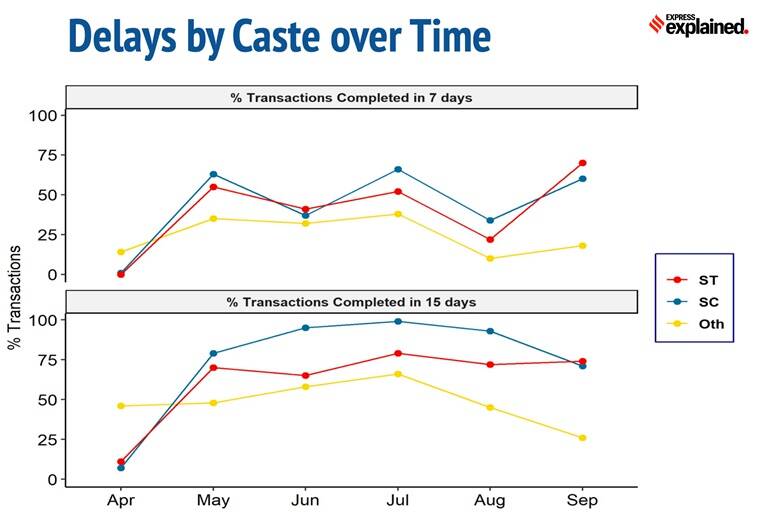
- Caste-based payment delays: This is perhaps the most unique finding of this year’s MGNREGA tracker
- In March 2021, the central government came out with a circular asking state governments to send three bills, officially called Funds Transfer Orders or FTOs, instead of just one for MGNREGA payments.
- So, instead of a single FTO stating that, say these 100 people have completed the work and that they should be paid their wages, the Union government has asked states to give 3 FTOs — one each for MGNREGA workers belonging to “SC” (Scheduled Castes), “ST” (Scheduled Tribes) and “Other” categories.
- Ineffective Role of PRI: With very little autonomy, gram panchayats are not able to implement this act in an effective and efficient manner.
- Large Number of Incomplete works: There has been a delay in the completion of works under MGNREGA and inspection of projects has been irregular. Also, there is an issue of quality of work and asset creation under MGNREGA.
- Fabrication of Job cards: There are several issues related to the existence of fake job cards, the inclusion of fictitious names, missing entries and delays in making entries in job cards.
Way Forward
Short-Term Measures
- State governments must ensure that public work gets started in every village. Workers turning up at the worksite should be provided work immediately, without much delay.
- Local bodies must proactively reach out to returned and quarantined migrant workers and help those in need to get job cards.
- Adequate facilities such as soap, water, and masks for workers must be provided free of cost, at the worksite.
- At this time, there is a need to speed up the payments to MGNREGA workers. Preferably, cash needs to reach the workers easily and efficiently.
Long-Term Measures
- The pandemic has demonstrated the importance of decentralised governance.
- Gram panchayats need to be provided with adequate resources, powers, and responsibilities to sanction works, provide work on demand, and authorise wage payments to ensure there are no delays in payments.
- MGNREGA should be converged with other schemes of the government. For example, Green India initiative, Swachh Bharat Abhiyan etc.
- Social Auditing creates accountability of performance, especially towards immediate stakeholders. Hence, there is a need to to create awareness regarding government policies and measures in rural areas.
- MGNREGA is a bottom-up, people-centred, demand-driven, self-selecting and rights-based programme.
- Thus, MGNREGA remains crucial for integrated resource management and livelihoods generation perspective.