
Only 7% of MSME credit to women; low female labour force participation drag on growth: RBI ED
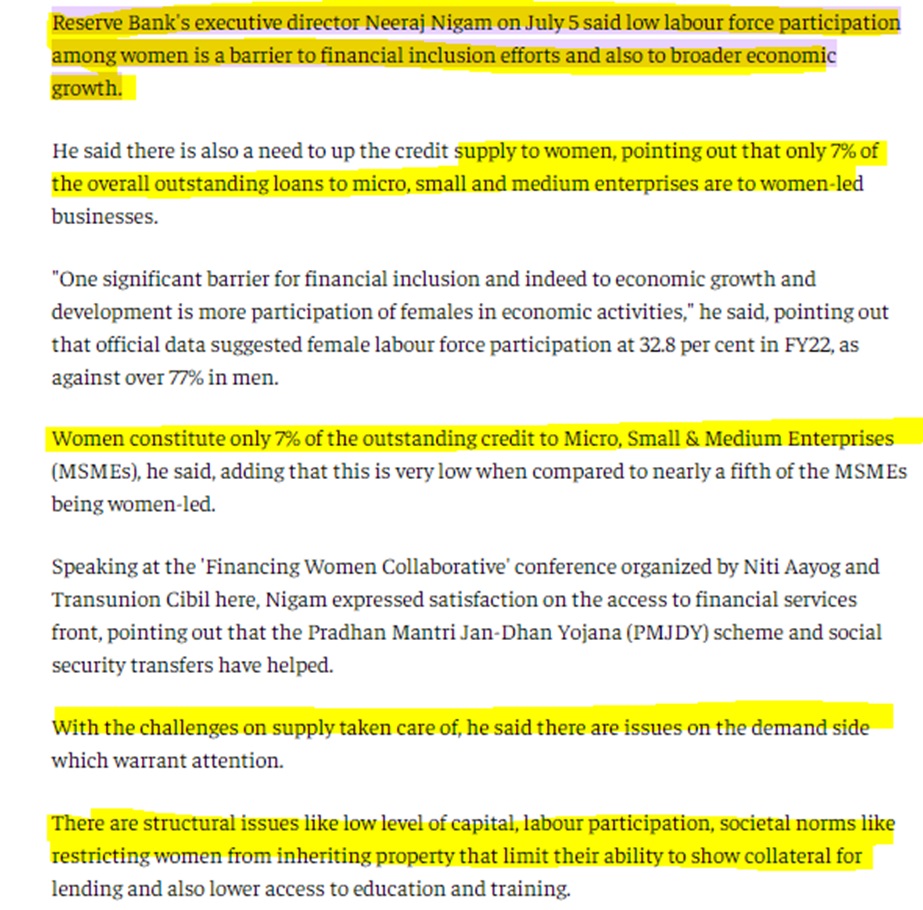
- The Reserve Bank's executive director said low labour force participation among women is a barrier to financial inclusion efforts and also to broader economic growth.
- There is also a need to up the credit supply to women, pointing out that only 7% of the overall outstanding loans to micro, small and medium enterprises are to women-led businesses.
Current Challenges in Women's Economic Participation
- Low Labor Force Participation Rates: There is a significant disparity between female (32.8%) and male (77%) participation rates.
- Credit Access Discrepancies: Despite women-led businesses comprising nearly a fifth of MSMEs, only 7% of MSME loans are allocated to them.
- Gender Inequality: India ranks 135th out of 146 countries in the 2022 World Economic Forum's Gender Gap Report, with gender disparities exceeding five percent.
- Gender Pay Gap: Oxfam India's 2022 Discrimination Report highlighted widespread gender pay discrepancies, compounded by biases in recruitment and pay practices.
- Barriers to Financial Inclusion: These include structural challenges like limited capital and societal norms, as well as perceptions and biases in the financial sector.
Pathways to Enhance Women's Participation
- Addressing Systemic Biases: Promoting fair assessment and treatment of women borrowers to mitigate biases in lending.
- Empowering Through Education: Enhancing financial literacy and providing skills training to improve economic opportunities.
- Ensuring Access to Capital: Facilitating easier access to credit with reasonable terms to support women entrepreneurs.
- Supporting Women-Led MSMEs: Offering tailored support and incentives to promote the growth and sustainability of businesses led by women.
Schemes to Promote Women Empowerment
- National Commission for Women: Established in 1992 to monitor and address issues related to women's rights and welfare.
- Reservation for Women in Local Self-Government: Mandated by the 73rd Constitutional Amendment Act of 1992 to ensure one-third reservation for women in elected offices in local bodies.
- Women's Reservation Act of 2023: Provides for reserved seats for women in constituencies by rotation.
- Pradhan Mantri Jan-Dhan Yojana: Aims to improve access to financial services for women.
- Priority Sector Lending (PSL) Mandate: Encourages banks and microlenders to extend credit to underserved segments, including women entrepreneurs.
- RBI Regulations: Mandates financial literacy centers to promote financial education in each district.
- Other Initiatives: Includes various government schemes and programs like Beti Bachao Beti Padhao, Pradhan Mantri Awas Yojana, National Social Assistance Programme, Samagra Shiksha, Mahila Shakti Kendra (MSK), and Mission Shakti, which focus on integrated women empowerment.