
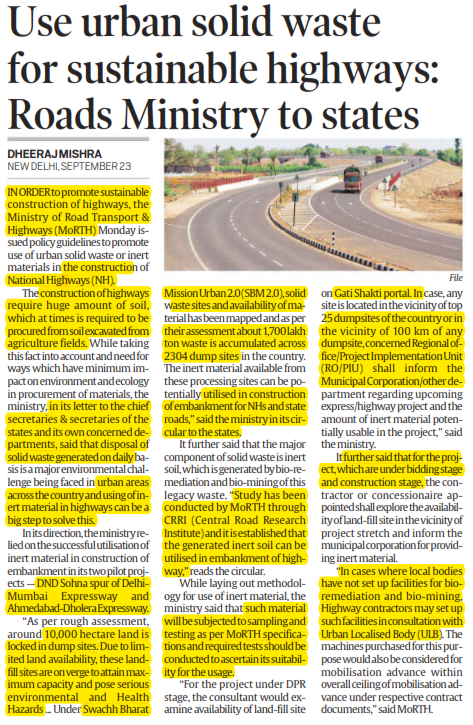
Use urban solid waste for sustainable highways: Roads Ministry to states
- The Ministry relied on the successful utilization of inert material in construction of embankment in its two pilot projects- DND Sohna spur of Delhi-Mumbai Expressway and Ahmedabad-Dholera Expressway.
Highlights:
- The Ministry of Road Transport & Highways (MoRTH) released new policy guidelines to promote the use of urban solid waste or inert materials in the construction of National Highways.
- The initiative aims to reduce the environmental impact of highway construction by utilizing waste materials that would otherwise occupy landfill space.
Environmental Challenges in Highway Construction:
- Highway construction requires large amounts of soil, often sourced from agricultural land, which can negatively impact the environment and ecology.
- The ministry, in a letter to state Chief Secretaries and relevant departments, noted that urban solid waste disposal is a major environmental challenge, and using inert materials in highway projects could help address this issue.
Pilot Projects: Proven Success:
- The ministry cited two successful pilot projects: the DND Sohna spur of the Delhi-Mumbai Expressway and the Ahmedabad-Dholera Expressway. These projects demonstrated the effective use of inert materials from solid waste in the construction of highway embankments.
Unlocking Land and Reducing Waste:
- The ministry highlighted that roughly 10,000 hectares of land in India are occupied by solid waste dump sites. With limited land availability, these sites are nearing capacity, posing serious environmental and health risks.
- Under the Swachh Bharat Mission Urban 2.0 (SBM 2.0), approximately 1,700 lakh tons of waste have been identified across 2,304 dump sites nationwide. The inert material from these sites could be repurposed for highway construction, reducing the environmental burden.
Research and Testing:
- A study conducted by MoRTH in collaboration with the Central Road Research Institute (CRRI) confirmed that inert soil generated through bio-remediation and bio-mining of solid waste is suitable for use in highway embankments.
- However, all materials will undergo sampling and testing according to MoRTH specifications to ensure their suitability.
Methodology for Using Inert Material:
- For projects in the Detailed Project Report (DPR) stage, consultants will assess the availability of landfill sites using the Gati Shakti portal.
- If a project is located near one of the top 25 dumpsites or within 100 km of any dumpsite, the relevant Regional Office or Project Implementation Unit (RO/PIU) will notify local authorities about the potential use of inert materials in highway construction.
Involvement of Contractors and Local Bodies:
- For projects in the bidding or construction phase, contractors or concessionaires will identify nearby landfill sites and coordinate with local municipalities to obtain inert material.
- In cases where local bodies have not set up bio-remediation and bio-mining facilities, highway contractors may establish such facilities in consultation with Urban Local Bodies (ULBs). Equipment purchased for this purpose will be eligible for mobilisation advances under the contract terms.
Prelims Takeaways:
- Urban Local Bodies (ULBs)